
What did Beethoven really look like?
Von Johannes Prominczel Director, Archives of the Gesellschaft der Musikfreunde in Wien
17.12.2024
It’s a story that could not be more Viennese: a work of art associated with the ‘First Viennese School of classical music’, a Jewish patron, a forced sale, emigration, restitution, and now the documentation of this story.
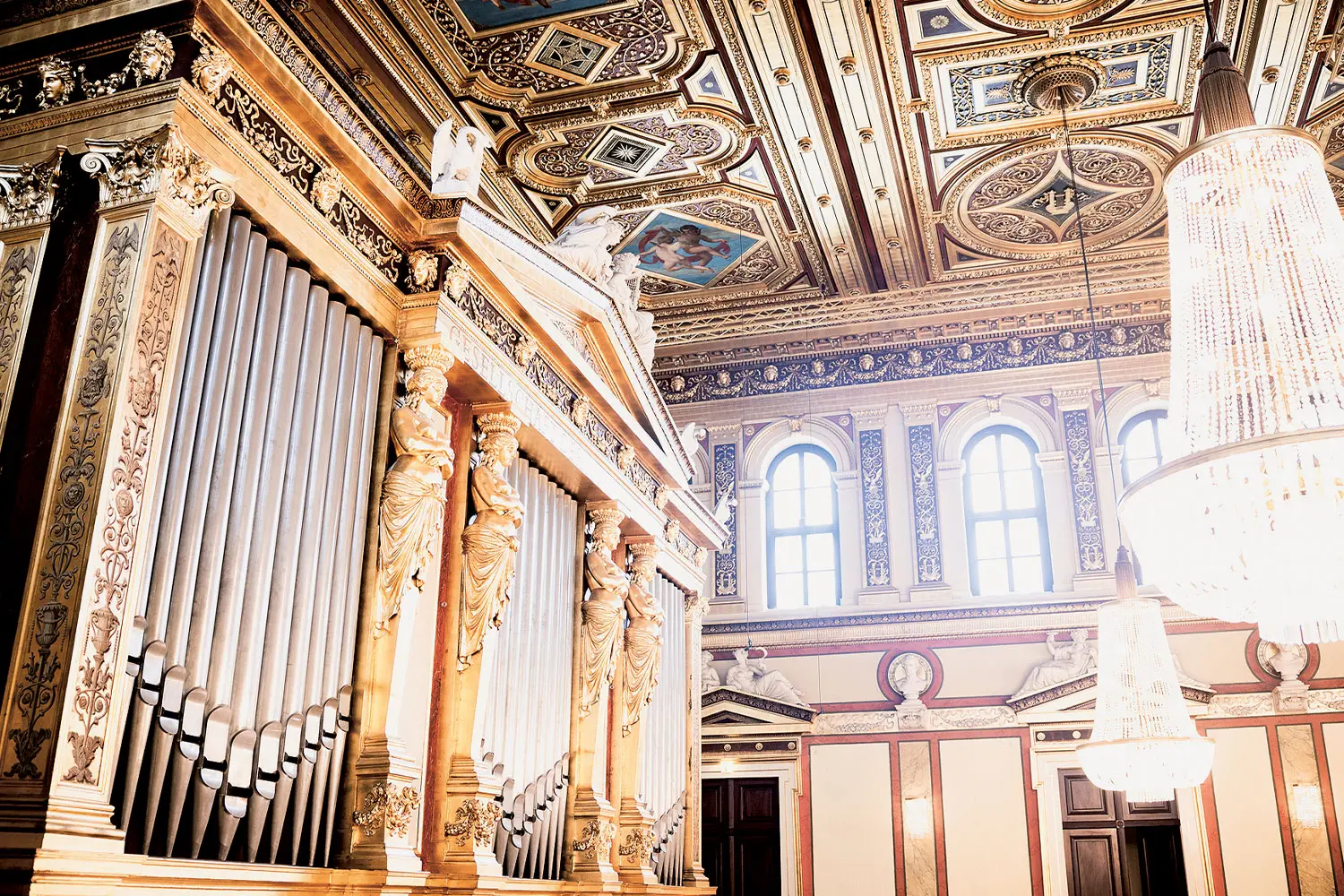
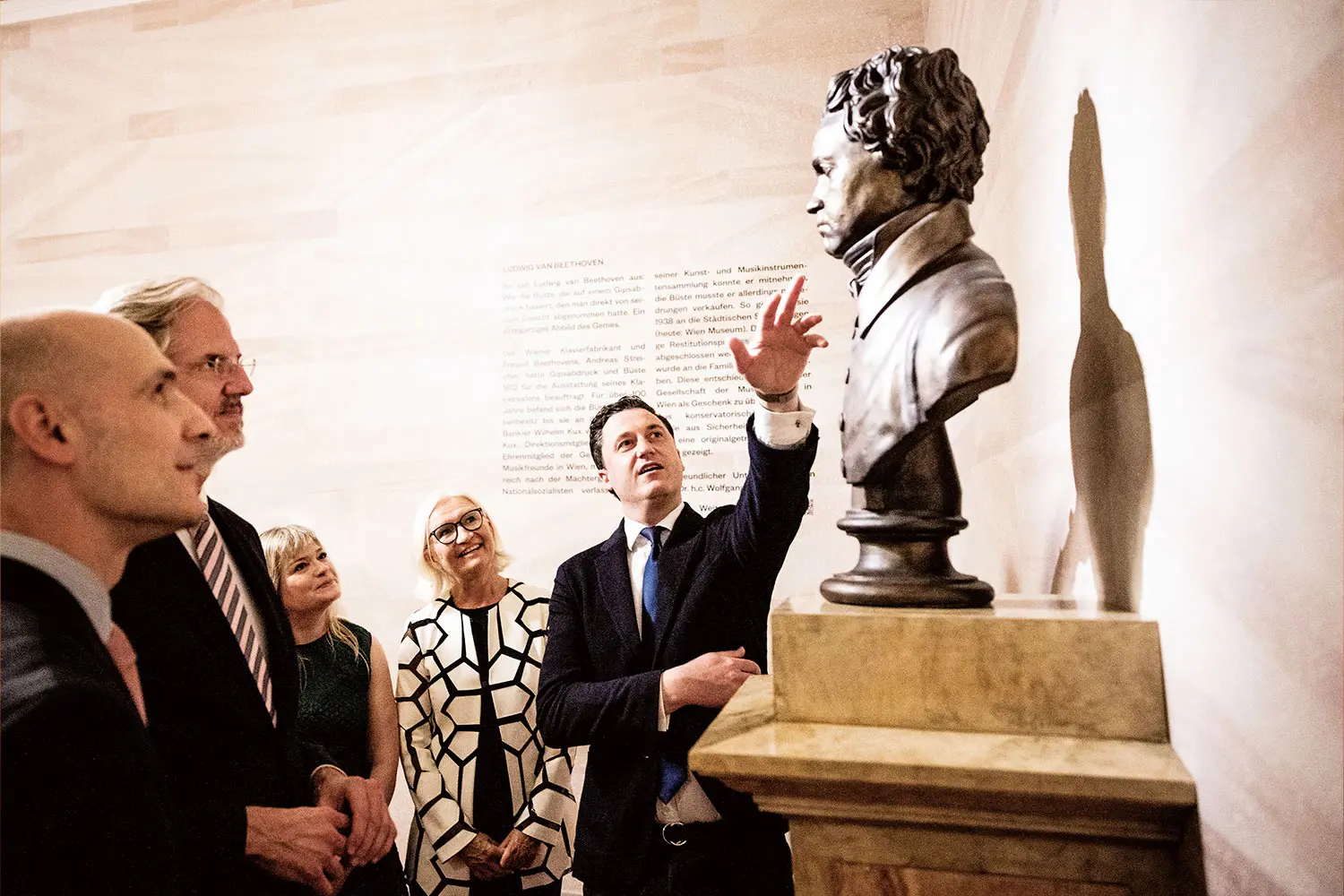
In 1812, Johann Andreas Streicher arranged for a life mask to be made of Ludwig van Beethoven. Streicher, a friend of Schiller’s, came from Stuttgart and worked in Vienna as a pianist and piano maker. By 1812, he was a founding member of the Gesellschaft der Musikfreunde in Wien and had also commissioned the building of a piano salon, which soon became a popular concert hall. The premises also doubled up as a showroom for the latest piano models. The hall was to be embellished with the busts of famous composers, and Beethoven agreed to submit to the process of having a life mask made, which required his face to be completely covered with quick-setting liquid plaster. Two straws had to be inserted into Beethoven’s nostrils so he could breathe. Apparently, it took two attempts for the procedure to succeed: during the first, Beethoven had ripped the plaster from his face. The sculptor and painter Franz Klein (1777–1840) then fashioned a bust from this life mask. And not just any bust. Indeed, it is so finely crafted that it is regarded as an authentic likeness of Beethoven, even though Klein made some minor adjustments, for example around the eyes. The clearly visible smallpox scars are testament to the fact that the bust is not a reconstructed ideal likeness. This is what Beethoven looked like.
The Streicher family owned several casts of the bust. In the 1920s, the family is thought to have sold a particularly fine example – a bronzed plaster cast – to Wilhelm Kux (1864–1965). Kux was the son of a doctor and originally from what is now Slovakia; as a child, he had studied the violin at the Conservatory of the Gesellschaft der Musikfreunde – albeit with minimal success, given that he was dismissed for reasons of ‘incompetence’. And while he went on to work in finance, he retained his love of music. After donating a substantial sum to the Musikfreunde Archives in the early 1920s for the purchase of a fragment of a Franz Schubert Lied (Der Tod und das Mädchen [Death and the Maiden], D 531), he was appointed to its board of directors in 1925 and remained on the committee until 1938, returning to it after the war. As of 1939, he took up residence in Switzerland. In 1947, Kux was awarded honorary membership of the Gesellschaft der Musikfreunde following several generous donations to the Musikfreunde Archives, including a number of letters and compositional sketches by Anton Bruckner as well as a string quartet by Johannes Brahms in the composer’s own hand. Wilhelm Kux died in Chur in 1965, aged 101.
Kux, who was Jewish, was forced to leave Austria once the Nazi regime had come to power. As a Czech citizen, he was permitted to leave the country. He was able to take some of his precious collection of autographs and musical instruments with him into exile in Switzerland, but had to leave other items behind. The available records show that he was not given permission to take the bronzed plaster bust of Beethoven out of the country as it was deemed a cultural asset of relevance to Austria.
And so, in 1938/39, the bust had to remain in Austria. Kux was compelled to sell it to the Städtische Sammlungen (present-day Wien Museum) for 3,000 Reichsmark. The story of the bust itself is set out in the Wien Museum records, where it is described as the bust created by Klein from which copies were later made. According to those records, not only is this bust the one originally to be found in Streicher’s piano salon, but it is also the one exhibited in 1927 at the City of Vienna’s Beethoven Centenary Exhibition marking the 100th anniversary of the composer’s death. Therefore, it was assumed that the bust once owned by Wilhelm Kux was not re-cast, but the very first and most important bust fashioned from the life mask itself.
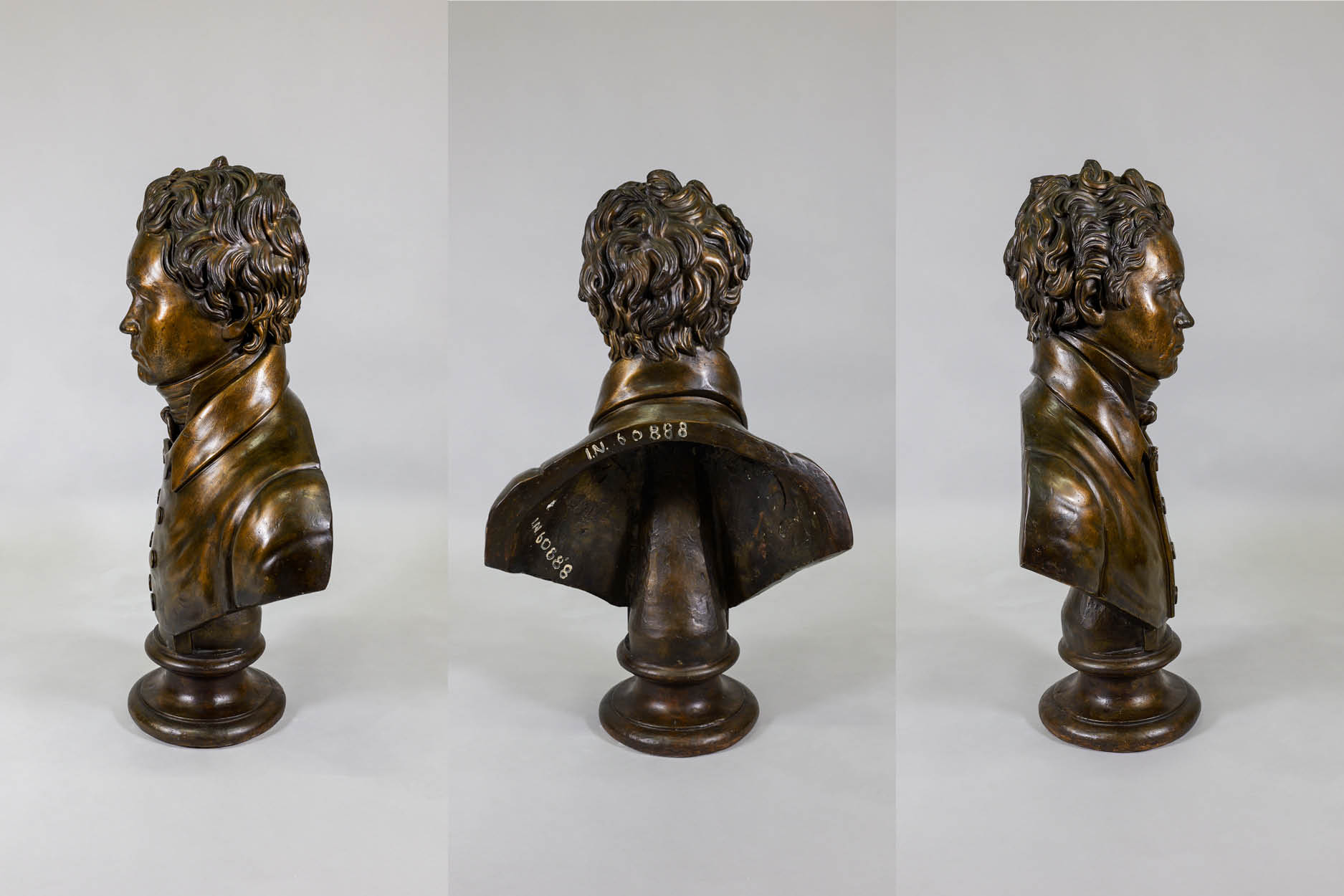
The 20th century saw a growing awareness that acquisitions made under the pressure of emigration were incompatible with today’s legal and ethical standards. In 2008, the Restitution Commission decided to return the bust to its rightful heirs. The search for the descendants proved difficult. Since Kux had died without issue, the heirs were therefore the children of his siblings, whose families are now scattered across the globe, including the US, Australia and Britain.
By 2023, the restitution process was coming to a conclusion. Through the mediation of the Wien Museum, the Gesellschaft der Musikfreunde in Wien contacted Rohan Kux, who represented the joint heirs. Ultimately, the family agreed to donate the invaluable bust to the Gesellschaft. The close relationship between his ‘great-great-uncle’ Wilhelm and the Gesellschaft proved crucial. Also the fact that Beethoven had been an honorary member of the Society and that Andreas Streicher, the long-time owner of the bust, was one of its founding members.
The bust – and its story – is unique. And that story has come full circle, as it were: from the piano maker Andreas Streicher to the displaced music lover and patron Wilhelm Kux to the restitution and donation to the Gesellschaft der Musikfreunde in Wien.
Weitere Artikel




17.12.2024
Beethoven, wie er wirklich aussah
17.12.2024
What did Beethoven really look like?
17.12.2024
それはまさにベートーヴェン
17.12.2024


